
Here is the English translation of an article at https://60ribo.org.il/kotel/ posted on Thu, 23 June 2022 = 24th of Sivan, 5782
The Wailing Wall, Known by the Masses as the “Western Wall,” Is Not One of the Walls of the Temple Mount
Introduction
After receiving a recommendation from one of the most active rabbis regarding ascending the Temple Mount, who mentioned he heard that Rabbi Avraham Shapira (the Rosh Yeshiva of Mercaz HaRav and former Chief Rabbi of Israel) had begun to permit it, I asked Rabbi Shapira the following question:
I prefaced my question to Rabbi Shapira by noting that years ago, I asked one of the prominent rabbis at Mercaz HaRav whether I was permitted to ascend the Temple Mount, and he replied, “No.” However, now (during the Second Intifada), when Israeli sovereignty over Jerusalem has severely deteriorated, perhaps in light of the situation, there is room to permit it now.
The Rabbi replied to me that indeed, if we knew the exact borders of the Temple Mount, it would be a mitzvah to ascend in order to strengthen the State of Israel’s sovereignty over Jerusalem. However, he added that he does not know where it is permitted and where it is forbidden to walk on the Temple Mount, and therefore he forbade me from going. Nevertheless, he defended those who do ascend, saying that apparently “they know.” Even so, he did not grant me permission to ask those who “do know,” but simply told me not to ascend.
Archeological and Halachic Evidence
Evidence published after Rabbi Shapira passed away proves that the Wailing Wall, known by the masses as the “Western Wall,” is not one of the actual walls of the Temple Mount. The Wailing Wall is an external retaining wall added by Herod (Hurdus) and his sons to expand the area of Mount Moriah. Certainly, one should not alter the measurement of the cubit (amah) or the location of the Temple based on measurements taken from the Wailing Wall (in contrast to the approach of Rabbi Shlomo Goren).
Many people find it difficult to accept the fact that the Western Wall is not one of the walls of the Temple Mount. This is because they misunderstood the words of the Midrash: “The Divine Presence (Shechinah) has never moved from the Western Wall.” The true intent of the Midrash is that the Shechinah never moved from the western wall of the Sanctuary (Heichal) or the western wall of the [original] Temple Mount.
This is the language of Midrash Tanchuma (Buber), Parashat Shemot, Siman 10:
Rabbi Acha said: The Shechinah never moves from the western wall of the Holy Temple, as it is said: “Behold, he stands behind our wall” (Song of Songs 2:9), That is “Hashem is in His holy Sanctuary.”
Shemot Rabbah (Shinan), Parshat Shemot, Parsha 2:
…And Rabbi Elazar said: The Shechinah never moved from within the Sanctuary… They said to him: Even though it is destroyed, The L-rd has not moved from there. Rabbi Acha said: The Shechinah never moves from the western wall, as it is said: “Behold, he stands behind our wall” (Song of Songs 2). “His eyes behold, His eyelids try the children of men” (Psalms 11).
Likewise, when Elisha ben Avuyah (“Acher”) explained to Rabbi Meir why he could not repent, he explained (Midrash Zutta – Kohelet {Ecclesiastes} (Buber), Chapter 7, Verse 8):
“Once I was riding a horse near the western wall of the Holy Temple, and I heard a prophetic echo (Bat Kol) emerging from the Holy of Holies, bursting forth and saying: ‘Return, faithless children (Yirmiyahu/Jeremiah 3:14), except for Elisha, who knew My power and rebelled against Me.’” (Note: Hearing is relative to a nearby location, meaning the western wall was adjacent to the Holy of Holies).
And so it is in Tanna Debei Eliyahu, Eliyahu Rabbah (Ish Shalom), Parsha 28:
Once, Rabbi Natan entered the Holy Temple and found it destroyed, with only one wall standing. He said, “What is the nature of this wall?” Someone said, “I will show you.” He took a ring and drove it into the wall, and that ring would move back and forth.
If the “Wailing Wall,” currently referred to as the “Western Wall,” were the only wall among the four Halachic walls of the Temple Mount to survive, we would expect its construction style to differ from the other walls. But this is not the case. Below, I have presented an image of the southwestern corner of the Temple Mount compound today. The style of the stones on the southern side is identical to the style on the western side.
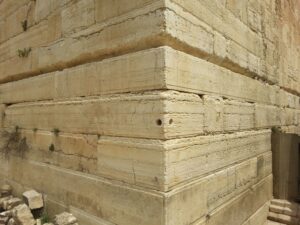
In fact, it is specifically on the eastern side of the Temple Mount compound that one can find a construction style that deviates from the rest of the wall.
Here I will quote from Asher Grossberg’s article in Techumin:
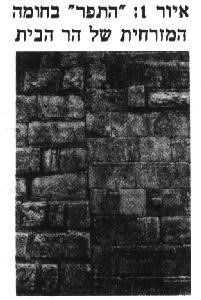
According to the writings of Josephus Flavius, Herod did not rebuild the eastern wall. He writes (Antiquities of the Jews 20.9.7 [219-222]) that in the year 64, they asked Agrippas to renew the eastern portico to utilize accumulated funds and prevent unemployment among the 18,000 workers engaged in building the Temple. Agrippas feared he would not be able to complete the construction of the portico, which was built upon the eastern wall—”the work of King Solomon”—and therefore refused the request. It appears that neither the eastern wall nor the portico atop it were rebuilt in Herod’s days, meaning that the expansion of the Temple Mount in the east-west direction could only be done toward the west.
The eastern wall of the Temple Mount is indeed built in a different style than the other walls. Only its southernmost 32 meters—from the area known as “the joint” southward—are built in the style of the other walls, as well as its northern section, slightly north of the Mercy Gate. This is particularly prominent in the northeastern tower. At “the joint” located in the south of the wall, it is clearly visible how the Herodian layers lean upon the layers north of them; therefore, it is clear that the section north of “the joint” predates Herodian construction. The Herodian construction starting at “the joint” continues along the southern and western walls and ends at the northern part of the eastern wall. (End of quote).
It should be noted that although Josephus claimed the eastern wall was the work of Solomon, this is questionable for reasons I will present in my extended article (which is yet to be published). However, regarding the Wailing Wall, popularly known as the “Western Wall,” I am convinced it was not built by King Solomon’s men.
Additional Reasons to Reject the Identification of the Wailing Wall as the Temple Mount Wall
In my extended, unpublished article, I brought sources showing there was a restriction against expanding the Halachic Temple Mount beyond 500 cubits by 500 cubits. Furthermore, according to Mikdash David (Kodashim, Siman 27, Ot 1) and Ohr Sameach (Hilchot Beit HaBechira, Chapter 6, Halacha 10), the entire 500 by 500 cubits of the Temple Mount must sit on Mount Moriah. However, the southwestern part of the Temple Mount walls extends into the Tyropoeon Valley and is not on the bedrock of Mount Moriah. If so, this implies that the true western wall of the Temple Mount was further inward, as the stone style indicates that all the lower stones of the Wailing Wall were built more or less during the same period.
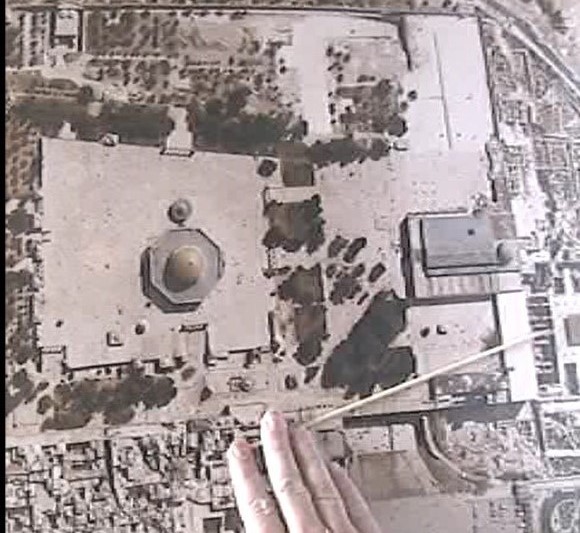
The section of the Wailing Wall (Western Wall) below the stick in the photo is the portion of the wall not built on Mount Moriah, but rather in the Tyropean Valley (according to topography experts). If so, it is highly unlikely that the Wailing Wall is actually the Halachic wall of the Temple Mount. I do not accept the excuse that perhaps, from the outset, they made part of the Wailing Wall for the sacred Temple Mount and part for secular purposes. It is highly improbable that sacred and secular uses would be mixed.
For a Halachic explanation of why it is difficult to accept a mixture of sacred and secular, see Maimonides (Rambam), Hilchot Beit HaBechira, Chapter 1, Halacha 20:
“All vessels must be made from their inception for sacred use. If they were initially made for an ordinary person (secular use), they may not be used for the Most High. Secular use is permitted with vessels intended for the Most High as long as they have not yet been used for the Most High; once they are used for the Most High, secular use is forbidden. Stones and beams originally hewn for a synagogue may not be used to build the Temple Mount.”
Aruch HaShulchan HeAtid, Hilchot Beit HaMikdash, Siman 4, Se’if 23:
- And the fact that items made for secular use are invalid, even though we hold that “designation is of no consequence” (hazmana lav milta hi), this applies to the essence of sanctity itself, where designation is of consequence, and therefore requires intent. Furthermore, it is a disgrace to bring into the Temple something made for secular purposes. And regarding what he wrote—that stones and beams hewn initially for a synagogue may not be used to build the Temple Mount—the version in the Tosefta there reads “hewn for secular use.” However, the Rambam teaches us an even greater novelty: that even for a synagogue, they may not be brought to the Temple Mount, because it is vastly holier, and relative to the Temple Mount, even a synagogue is considered secular (Kessef Mishneh). Nonetheless, it is surprising why he changed the wording. It seems the Rambam holds that if the Tosefta meant strictly secular use, what novelty does it teach us that we wouldn’t already know from the previous rule? [The primary reason is the second one: due to disgrace. For if designation were of consequence here, why is it permitted to use it for secular purposes before it is used for the Most High, given that it was designated? Therefore, it must certainly be as I wrote].
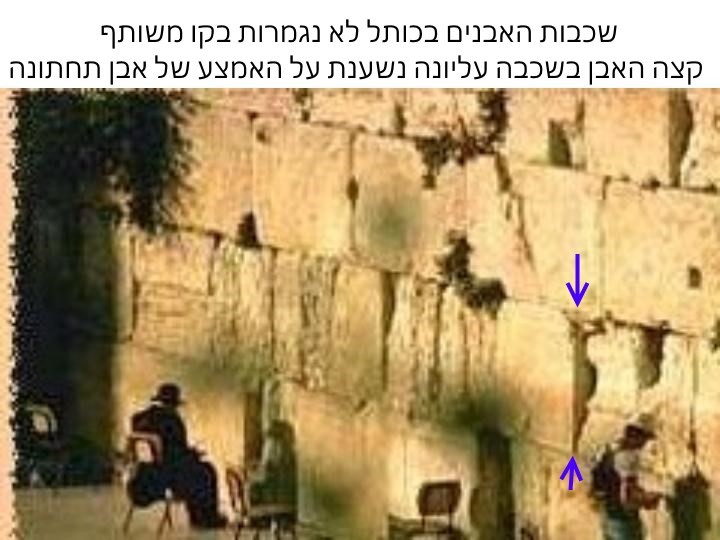
A Section of the Wailing Wall
It is implied from his words that it is a disgrace for a stone on the border of the 500 cubits of the Temple Mount on the western side to be used half for holy purposes and half for secular purposes.
Furthermore, it poses a difficulty because secular structures are forbidden to lean on a sacred stone, as written in Rambam, Hilchot Me’ilah, Chapter 8, Halacha 4:
Halacha 4
When building the Temple, they do not take wood and stones from consecrated property, nor do they construct the building with the intent that it is holy. Rather, they build everything from secular funds, as a decree lest someone benefits from the shadow of the building or leans on a stone or beam during the work. After the building is completed, they deconsecrate the sacred money onto the building. If the treasurers required wood for sacred use for that day alone, they could take it from sacred funds, since they would not remain for days, so we do not worry lest someone lean on them and commit sacrilege (Me’ilah).
And Shu”t Igrot Moshe, Yoreh Deah, Part 4, Siman 63 writes:
“And regarding the walls of the Temple Mount, this is the intent of the Rambam in Chapter 8 of Me’ilah, Halacha 4, where he wrote: ‘When building the Temple, they do not take wood and stones from consecrated property… rather they build everything from secular funds.'” (End of quote).
I have no explanation as to why Rabbi Feinstein, in a different responsa, did refer to the Wailing Wall as the wall of the Temple Mount.
Now perhaps one could counter that a valley adjacent to Mount Moriah is also defined as Mount Moriah. For in Rashi’s view, the Temple Mount in the future will expand to 3,000 cubits by 3,000 cubits, which, according to modern geography, includes areas outside of Mount Moriah. (This counter-argument explains why it might be possible to view the southwestern corner as the Temple Mount, but it does not resolve the issue of secular use mixed with sacred use on the other side of the Wailing Wall).
Archeological Discoveries and Historical Accounts
Coins from the Herodian dynasty were found in ritual baths (mikvaot) that were filled with dirt and stones underneath the wall. This indicates that the wall was built only a short time before the destruction of the Holy Temple, which aligns with the historical writings of Josephus Flavius.
In an article by the Israel Antiquities Authority published several years after Rabbi Shapira’s passing, it is written:
Building the Western Wall: Herod Started it, but Didn’t Finish (23/11/2011)
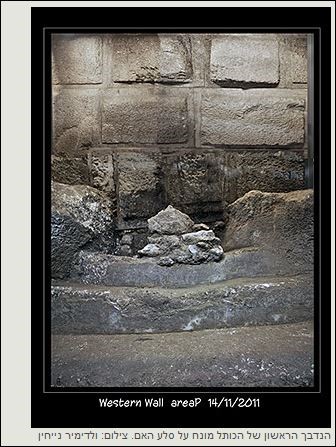
Prof. Ronny Reich of the University of Haifa and Eli Shukron of the Antiquities Authority: A ritual bath (mikveh) uncovered beneath the Western Wall of the Temple Mount indicates that the construction of the Western Wall of the Temple Mount was not completed during King Herod’s lifetime.Who built the walls of the Temple Mount? Any tour guide and any student familiar with the history of Jerusalem would immediately answer that it was Herod. However, in archaeological excavations alongside the ancient drainage channel of Jerusalem, an ancient ritual bath was recently discovered that challenges the accepted archaeological perception regarding Herod’s exclusive responsibility for the construction.
Recently, support and maintenance work was conducted on the paving of Jerusalem’s main street from 2,000 years ago, which was used by pilgrims ascending the Temple. This was part of a project to re-expose the drainage channel that ran beneath the street, stretching from the Siloam Pool in the City of David to the archaeological garden of Jerusalem near the Western Wall. The excavations are conducted at the site on behalf of the Antiquities Authority in cooperation with the Nature and Parks Authority and the East Jerusalem Development Company, funded by the Elad Association. They are managed by archaeologist Eli Shukron on behalf of the Antiquities Authority, with the assistance of Prof. Ronny Reich of Haifa University.
In the excavation beneath the paved street next to Robinson’s Arch, sections of the foundations of the Western Wall resting on bedrock were exposed—which also serves as the western foundation of ‘Robinson’s Arch’—a massive arch that carried a staircase leading from the main street of Jerusalem to the entrance of the Temple Mount compound.
According to Prof. Reich, “During the work, it became clear that within the natural rock, there are hewn remains of various installations, including water cisterns, ritual baths, and cellars. These belonged to a residential neighborhood that existed on the site before King Herod decided to expand the Temple Mount compound. The contemporary Jewish historian Josephus Flavius relates that Herod began the expansion project of the compound in the eighteenth year of his reign (22 BCE) and defines the expansion as ‘the greatest project humanity has ever heard of.‘
Once the expansion was decided upon, the area was expropriated, and the walls of the houses were removed down to the bedrock. The rock-hewn installations were filled with dirt and stones so that building could take place over them. When the corners of the Temple Mount were established and the placement of the first layer began, it turned out that one of the ritual baths was located exactly along the route of the Western Wall. The builders filled the mikveh with earth, placed three large flat stones on top of the earth, and built the first layer of the Wall over this filling.”
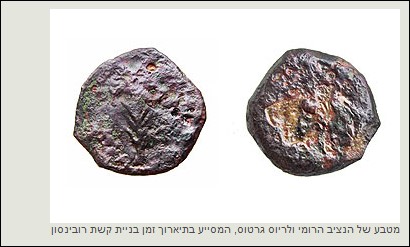
Sifting the dirt from inside the sealed mikveh yielded three clay lamps of the type common in the 1st century CE. Additionally, seventeen identifiable bronze coins were extracted during sifting. Dr. Donald Ariel, curator of coins at the Antiquities Authority, determined that the latest coins (four in total) were minted by the Roman procurator Valerius Gratus in the year 17/18 CE. This means that Robinson’s Arch, and perhaps a longer section of the Western Wall, were built after this year—meaning at least 20 years after Herod’s death (which occurred, according to popular belief, in 4 BCE).
This archaeological data illustrates the fact that the construction of the Temple Mount walls and Robinson’s Arch was a massive undertaking that spanned decades and was not completed in Herod’s lifetime.
This dramatic find corroborates the descriptions of Josephus Flavius, who reports that only in the days of King Agrippas II (Herod’s great-grandson) was the work completed, leaving eighteen thousand unemployed workers in Jerusalem upon its conclusion.
In conclusion: According to what is written in the article, it is clear that the Wailing Wall, referred to as the “Western Wall,” was not built in the days of Solomon, because it is highly improbable that a mikveh containing artifacts from the Herodian period would be found beneath a Halachic western wall of the Temple Mount. It only makes sense that the mikveh with the coins and Herodian-era artifacts was there because the Wailing Wall was built as part of Herod’s extension to reinforce and expand the Mount.
Yet Another Reason to Reject the Identification of the Wailing Wall as the Halachic Wall
As I have already noted in my extended, unpublished article, the eastern wall is not parallel to the Wailing Wall, and by any measure of the cubit (amah) that one chooses, it will not result in a square of 500 cubits by 500 cubits as required by the Kaftor VaFerach: “The Temple Mount is a perfect square surrounded by a wall, 500 cubits by 500 cubits. And in the words of Yechezkel (Ezekiel) the Prophet (40:17-19), the Temple Mount is called the Outer Courtyard, and the Azarah is called the Inner Courtyard.”
It is worth noting that in the Vilna Gaon’s (Gra) commentary on the Outer Courtyard of the future Temple (which is the Temple Mount according to the Kaftor VaFerach), we see that the 500 by 500 measurement is precise and does not include the walls of the Temple Mount. I also found this in the commentary Alei Tamar on Jerusalem Talmud, Berachot, Chapter 9, Halacha 5:
“And it must be said that the Temple Mount itself is called the King’s Gate… because it aligns with the Outer Courtyard of the future Temple, as written by the Rambam in Hilchot Beit HaBechira, Chapter 1, Halacha 4.”
Proof that the 500 cubits of the Temple Mount do not include the thickness of the wall comes from the Jerusalem Talmud, Pesachim, Chapter 7, Halacha 12:
“Rabbi Yochanan bar Madaya in the name of Rabbi Pinchas: From the fact that we see the Rabbis removing their sandals beneath the *aguf of the Temple Mount, this indicates they did not sanctify the area beneath the aguf of the Temple Mount.” This aguf area (or according to Rabbeinu Chananel, Pesachim81b, it is pronounced agaf) is located within the perimeter taken up by the thickness of the walls.
(* Google translates aguf as gatehouse, but I think that this is not precise, so I decided to write just a transliteration without an English translation.)
Korban HaEidah, Pesachim, Chapter 7, Halacha 12:
“From the fact that we see…” Since we see that the Sages place their sandals beneath the aguf of the Temple Mount—as it is forbidden to enter the Temple Mount with one’s sandals:
“This indicates…” Meaning that the aguf of the Temple Mount was not sanctified, and therefore they did not sanctify it so that shoes and sandals could be left there.
Pnei Moshe, Pesachim, Chapter 7, Halacha 12:
“Removing…” Stripping off their sandals and leaving them beneath the aguf of the Temple Mount when entering. If so, what does “this indicates they did not sanctify” mean? For we learned: “A person may not enter the Temple Mount with his staff and his sandals,” so it certainly does not possess the sanctity of the Temple Mount.
I have expanded slightly on this point to hint at some of the reasons why I also do not accept the approach of Rabbi Elkana Lior, Shlit”a, since according to his approach, one of the corners of the Temple Mount is at an angle of 91 degrees rather than 90 degrees, and Rabbi E. Lior also included the thickness of the walls in his calculation of the 500 cubits by 500 cubits.
If Our Wailing Wall Is Not the Western Wall That Was Never Destroyed, Where Is It?
In Rabbi Iddo Elba’s article, “The Obligation to Maintain Tradition – The Dome Is Built on the Site of the Temple,” on page 7, we learn:
The Christian Sozomen (Ecclesiastical History, Book 5, Chapter 22) recounts that during the reign of Emperor Julian (363 CE), the emperor wanted to rebuild the Temple for the Jews, and “when they cleared the ruins of the previous building, they dug into the earth and cleared its foundations.” This implies he is speaking about uncovering the foundations of the previous building of the Jewish Temple.
Chrysostom, the Bishop of Constantinople (died 407 CE), refers to their tradition that J-man (of the Christian religion) stood on the site of the Temple and declared that “not one stone will be left upon another,” and wrote: “Not one stone will be left upon another—if so, how did [the remains of the Jewish Temple] remain?… Because he [J-man] said these words with the meaning, either that it would be abandoned [and not totally demolished], or he was speaking about the specific spot where he was standing. For there are places that were destroyed down to the foundation.”
His words prove that the existence of the Temple ruins even after Julian was so open and well-known that even the Bishop could not deny it, despite it being entirely inconvenient for him, forcing him to find forced explanations and say that at least some places were destroyed to the bedrock.
On page 6 of the same article, Rabbi Elba cited Ginzei HaGeonim, Bava Batra 60b, that when the [Muslims] extended their hand and conquered the Land of the Tzvi (Israel) from Edom (the Byzantines) and came to Jerusalem, there were men from the Children of Israel with them who showed them the site of the Temple… and they made stipulations with them that they would honor the Holy Temple from all defilement.
Rabbi Benjamin of Tudela – Visited the Land roughly 60 years after the Crusaders captured Jerusalem from the Muslims:
And this is what he wrote:
“And the Gate of Jehoshaphat (Yehoshafat) is in front of the Holy Temple which existed in ancient times. And there is the Templum Domini, which was the site of the Temple, and Umar ibn al-Khattab built a very large and beautiful dome over it, and no Gentile brings any idol or any image there, but they come only to recite their prayers. And in front of that place is the Western Wall, one of the walls that were in the Temple in the Holy of Holies, and they call it the Gate of Mercy, and there all the Jews come to pray before the wall in the courtyard.
And there in Jerusalem, at the house that belonged to Solomon, are the horse stables which Solomon built as a very strong structure of massive stones, the likes of which have not been seen in all the land.”
From the words of Rabbi Benjamin of Tudela, we see:
- That in his time, they defined the Western Wall as one of the walls of the Holy of Holies, and not the Wailing Wall that we call the Western Wall today.
- The Jews came very close to the western wall of the Holy of Holies (either because they held like the Ra’avad according to the Meiri’s interpretation, or they distanced themselves the minimal distance required by the Rambam to keep away from the camp of the Shechinah).
- Rabbi Benjamin of Tudela assumed that the purpose of the giant stones he found in Jerusalem was to house Solomon’s horses. He did not know that their true purpose was to expand the Mount as a retaining wall built by Herod’s builders.
What I meant to say by this is that there is room to argue that Rabbi Benjamin of Tudela did not view the giant stones he found at the southwestern corner of the Temple Mount as the Halachic walls of the Temple Mount. Rather, he found an alternative explanation for why giant stones were there.
And what some of the Rishonim from other periods assumed—that the Wailing Wall is the Western Wall of the Temple Mount—was not based on a tradition, but on logical reasoning (sevara). They found no reason to move stones of such immense weight to Mount Moriah except for the purpose of separating the sanctity of Jerusalem from the sanctity of the Temple Mount. But today we know that the necessity was for a retaining wall to expand the Mount. Alternatively, they did not know that Herod possessed greater technological capability than King Solomon to move heavy stones, but such is the truth, just as in our generation we possess greater technological capability than all the generations before us.
I also reject the proposal that perhaps Herod rebuilt the Halachic Western Wall and made part of it sacred for the Temple Mount and part for secular needs. It makes no sense at all that he would create a chaotic mix of sacred and secular, and we find no mention in Chazal (the Sages) that Herod did such a thing. Furthermore, it is somewhat implied in Bava Batra 3b that Herod’s construction was done according to the will of the sage Baba ben Buta. And so it is written in Tractate Taanit, page 23a:
“And so we found in the days of Herod that they were engaged in the construction of the Holy Temple, and rain would fall at night. The next morning, the wind blew, the clouds dispersed, the sun shone, and the people went out to their work, and they knew that the work of Heaven was in their hands.”
Written by Shlomo Moshe Scheinman