
Summary by GEMINI AI
 Dr. Ben Ari opens his lecture with the traditional greetings of “Chag Sameach and Shabbat Shalom,” highlighting the unique calendar confluence (in 5786 / 2026) where the festival of Shavuot (the Giving of the Torah) directly connects into the holy Shabbat of Parashat *Naso*.
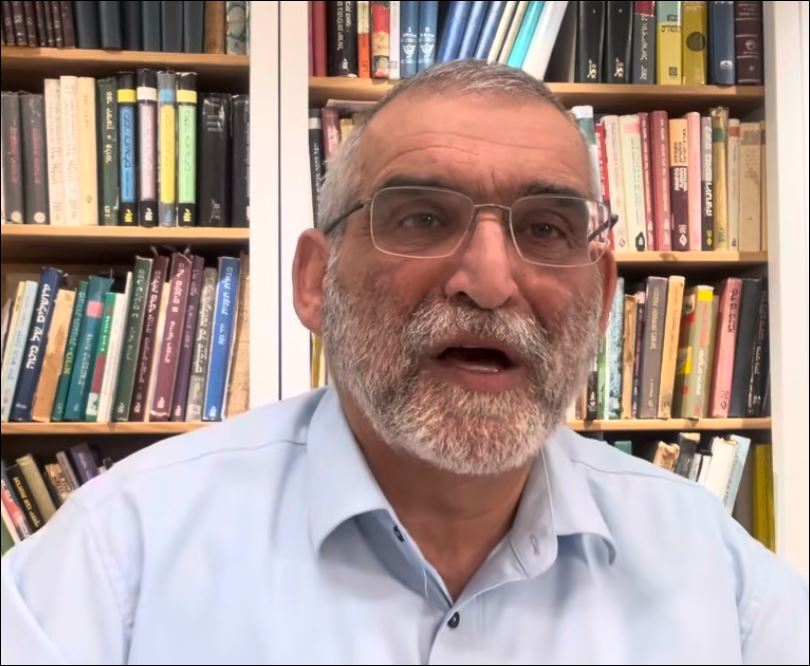 Dr. Ben Ari opens his lecture with the traditional greetings of “Chag Sameach and Shabbat Shalom,” highlighting the unique calendar confluence (in 5786 / 2026) where the festival of Shavuot (the Giving of the Torah) directly connects into the holy Shabbat of Parashat *Naso*.
1. The Essence of Matan Torah: The ID Card of the Jewish People
The lecturer explains that just as every nation possesses a defining symbol or monument that captures its identity (like the Eiffel Tower for France), the Jewish people’s identity is defined by the Torah. He quotes Rav Saadia Gaon: *”Our nation is only a nation by virtue of its Torahs.”*
* **A Top-Down Revelation:** A foundational element of Jewish faith is that the Torah was not invented by human sages. Rather, it was a top-down revelation from G-d at Mount Sinai. The Talmudic concept that G-d *”held the mountain over them like a cask”* signifies that the Torah is an absolute, binding reality, not subject to human alteration or personal whim.
* **”Were it not for this day”:** Dr. Ben Ari shares the Talmudic anecdote of the sage Rav Joseph, who celebrated Shavuot by stating: *”Were it not for this day, how many ‘Josephs’ would there be in the marketplace?”* The Torah is what elevates, individualizes, and preserves the Jew; without it, the nation would dissolve and disappear in the diaspora.
* **Passing the Torch:** Mentioning the self-sacrifice of Jews during the Roman persecutions in the days of Rabbi Akiva, he emphasizes the commandment of *”and you shall teach them diligently to your children.”* Studying Torah with one’s children—even for just 5 or 10 minutes a day—is crucial for maintaining Jewish continuity.
2. Megillat Ruth: Simplicity, Nature, and the Spirit of Lovingkindness
As a Bible (Tanakh) teacher of many years, Dr. Ben Ari expresses a deep, uniquely emotional connection to the Book of Ruth. He describes it as a text that provides “tranquility to the soul” and a comforting place “to rest one’s head.”
* **The Landscape of the Land:** Most of the narrative unfolds in the wide-open spaces, fields, and threshing floors of the Land of Israel during the barley and wheat harvests. This agricultural setting infuses the story with a natural, serene atmosphere.
* **The Greatness of Small Acts (Boaz’s Toast):** The lecturer highlights the text’s profound simplicity through the scene where Boaz roasts grain for Ruth (*”And he offered her parched corn, and she did eat, and was sufficed, and left thereof”*). The Sages note that if Boaz had known this minor act would be eternally recorded in the Bible, he would have prepared a lavish feast with top chefs. Yet, the true power of the Megillah lies in this unpretentious, natural benevolence and open-heartedness.
3. The Sin of Elimelech vs. Mutual Responsibility
Dr. Ben Ari draws a sharp contrast between the altruism of the Megillah’s protagonists and the behavior of Elimelech, who deserted the Land of Israel for the fields of Moab during a famine.
* **Elimelech’s Alienation:** The Sages judge Elimelech harshly. As a wealthy leader of his generation, he should have opened his storehouses to help the community weather the crisis together. Instead, he chose self-preservation and fled.
* **Separating from the Community:** The lecturer references the rabbinic dictum: *”When the community is suffering, a person must not say: ‘I will go to my home, eat and drink…'”* Those who separate themselves from the community in times of trouble will not live to see its consolation—as evidenced by Elimelech’s family, who lost all their wealth and whose sons (Mahlon and Chilion) died abroad.
* **A Modern Analogy:** He shares a poignant story about the late father-in-law of Noam Federman (David Haramati, a righteous convert). During the Yom Kippur War, while still a non-Jew abroad, he witnessed young Jewish men rushing to public telephones to book flights back to Israel to fight for their country. This display of absolute mutual responsibility deeply moved him, inspiring him to convert and join the Jewish people.
4. Ruth’s Devotion and Her Heroic Speech
Upon hearing that *”the Lord had remembered His people in giving them bread,”* Naomi decides to return to Bethlehem. On the road, she attempts to convince her daughters-in-law, Orpah and Ruth, to return to their maternal homes, realistically painting a bleak picture of their future if they stay with her.
* **Orpah vs. Ruth:** Orpah makes a pragmatic, realistic calculation, kisses her mother-in-law goodbye, and turns back. In contrast, **”Ruth clung to her.”**
* **Ruth’s Absolute Resolve:** Ruth delivers a magnificent speech born of pure internal truth: *”For whither thou goest, I will go… thy people shall be my people, and thy G-d my G-d; where thou diest, will I die, and there will I be buried.”* Ruth is not seeking wealth or future royalty; she is entirely prepared to pay the heaviest price to bind her fate to the Jewish nation and its Torah under the wings of the Divine Presence.
5. The Encounter in the Field and Family Redemption
Ruth goes to glean ears of corn in the field of Boaz (fulfilling the biblical commandment of *Leket*, which protects the poor). Boaz, a wealthy landowner, is revealed to be a deeply sensitive man who treats his laborers with profound respect.
* **Welcoming Countenance (*Hesbarat Panim*):** Boaz notices Ruth, ensures her safety from harassment, and invites her to drink water alongside his youths. Ruth bows to the ground, asking why she has found such favor and hospitality since she is a foreigner. Boaz replies that he was fully informed of the immense kindness she showed Naomi, comparing her journey to that of Abraham, who left his father’s house and birthplace for an unknown land.
* **Initiative and Redemption:** Naomi realizes that Boaz is a close relative and a potential redeemer (*Goel*). When the harvest season concludes and no action has been taken, Naomi proactively orchestrates the encounter at the threshing floor. Boaz eagerly steps into the role of the redeemer.
* **Resolution of the Crises:** The lecturer concludes by citing the late Rabbi Professor Yehuda Kiel (editor of the *Da’at Mikra* commentary) regarding the two core crises in the Megillah:
- **The National Crisis (Famine):** Resolved early on when God remembers His people with bread.
- **The Family Crisis (Death and Extinction):** Resolved at the climax through the marriage of Boaz and Ruth and the birth of their son, Oved, the grandfather of King David.
Conclusion and Contemporary Prayer
Dr. Ben Ari closes his lecture with a sobering yet hopeful reflection on current events. In these challenging times (May 2026 | Sivan 5786), marked by national grief, fallen soldiers, bereaved families, and widows, he offers a heartfelt prayer that G-d remember His people on both the national and personal levels, bring speedy salvation and redemption, and cause the horn of His servant David to flourish.