
The following is an excerpt from the Koren – Steinsaltz) translation of Baba Batra 26a as found in the Sefaria web site.
The Gemara relates an incident about palm trees that caused damage to a vineyard.
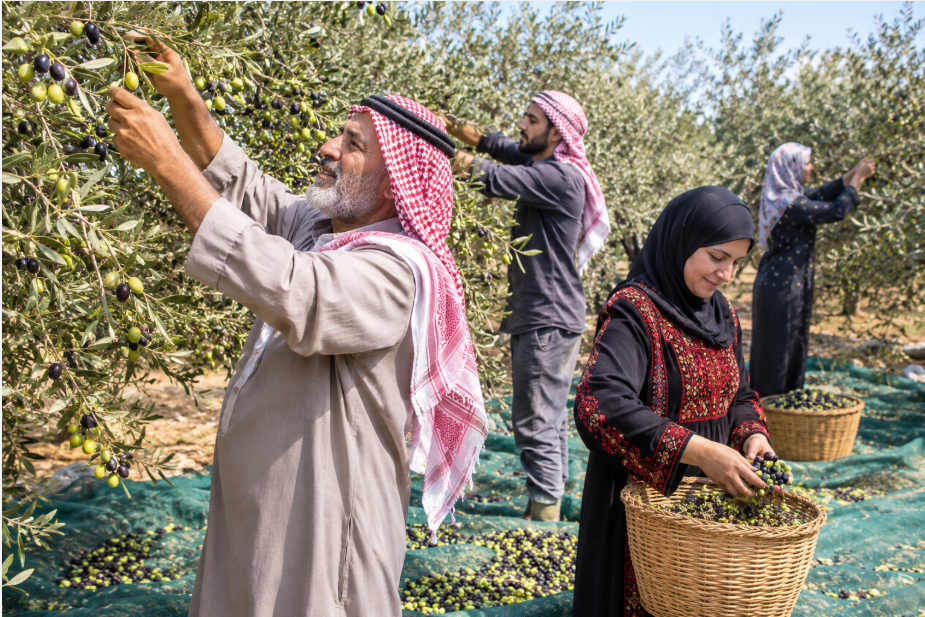
See: https://hilltopmaccabees.org/2026/10/04/olive-harvest-season-officially-opened-last-friday-morning-anarchists-flood-the-area/ and https://hilltopmaccabees.org/2026/10/21/olives-harvesting-torah-law-vs-turkish-law/ for a better idea why this picture was inserted.
Daf Al Hadaf Commentary
Daf Al HaDaf, Tractate Bava Batra, Page 26a
In the Gemara: “Rava bar Chanan (Hanan), etc. And Rabbi Chanina (Hanina) said: ‘My son Shikhchat died only because he cut down a fig tree before its time.'”
Now, in Tosafot (s.v. Ana), they wrote that Rava’s palm trees were damaging Rav Yosef’s vines only slightly, and therefore he was concerned in this case about bal tashchit (“do not destroy”); thus far their words. And the Ramban raised a difficulty against Tosafot: What difference is there between slight damage and substantial damage? After all, a person must give everything he owns rather than cause his fellow a loss of even a shaveh perutah (the minimal monetary value of a perutah). It is clear from the Ramban that he holds that since one is commanded to distance [the source of damage] under the law of a damager (mazik), he therefore need not be concerned in this case about bal tashchit.
And it is written in the book Otzrot Yehoshua (Section 11, Subsection 1): According to the view of Tosafot, one must say that indeed, in general Rava held that a person must give all his money, etc. Not so here, however, where there was a concern of mortal danger (sakanat nefashot), and even the severe [prohibition of] Shabbat is pushed aside for saving a life (pikuach nefesh). And according to the view of the Ramban, one can say that he holds that since there is a prohibition against causing damage, he should have had the palm trees cut down by a non-Jew (as the Poskim wrote, that where it is permitted, one should have the tree cut down by a non-Jew).
Thus it becomes clear that Tosafot and the Ramban disagree in a case where it causes a slight loss, as to whether one must be concerned in this case about bal tashchit. And it is written in the book Divrei Shalom (Vol. 1, Section 14) that one can make the aforementioned discussion dependent on the dispute between the Rambam and the Ramban. For the Rambam in Sefer HaMitzvot, Negative Commandment 57, wrote that we were warned against destroying trees when we besiege a city in order to distress its people and pain them, etc. However, the Ramban in his Addenda to the Positive Commandments (p. 21a, Positive Commandment 6) wrote: “And likewise during the days of the siege, to distress the people of the city by destroying the trees so that they do not sustain themselves from them – all this is permitted, for the Torah forbade only wanton destruction [hashchatah be-chinam],” and he added there that the wording of the Rambam in the aforementioned Negative Commandment is imprecise. His intent is that from the aforementioned Rambam it implies that destroying trees to distress the people of the city is forbidden in all circumstances; see there.
And he explained there in Divrei Shalom that the dispute rests upon an introductory inquiry into the conceptual definition (geder) of the prohibition of bal tashchit: whether the prohibition is on account of the object itself – just as they said in Shabbat (77b) that everything the Holy One, blessed be He, created in His world, He did not create a single thing in vain, and therefore it is forbidden to destroy it – or perhaps the prohibition is from the perspective of the person, that it is unfitting for a person to destroy something from which he can derive benefit. He explained there that this is what the Rambam and the Ramban argue about: the Rambam adopted the first side, that it is on account of the object, and therefore the Rambam holds that one may not cut them down to build a siegework or to distress the inhabitants of the city, because it does not make sense to permit taking something created for the sustenance of human beings and using it for the opposite purpose. By contrast, the Ramban adopted the second side, that it is from the perspective of the person – that whenever one has benefit from the object, he should not destroy it; therefore, in a case where from the very act of destruction he also derives benefit, such as wanting to distress the enemy, it is entirely fine. And so it is explicitly clear from the Ramban’s commentary on the Torah in Deuteronomy (20:19), where he wrote in these words: “And the reason for ‘you shall destroy it’ is that it is permitted to cut down and build a siegework, for the destruction is for the sake of conquest – such as when the people of the city go out and gather wood or hide there in the forest to fight you.”
Based on this, the approach of the Ramban is well explained: according to his view that when a person derives benefit it is entirely fine, so too in our case – since by uprooting the tree he will no longer be considered one who damages his fellow, there is no greater need than this, and it is entirely permitted. However, Tosafot hold like the Rambam that the prohibition is on account of the object; and since fruit trees were given for human enjoyment, they therefore hold that only when the tree causes substantial damage to others should one uproot it, for otherwise, what makes this [interest] stronger than that [prohibition]?