
This is the answer of Gemini AI
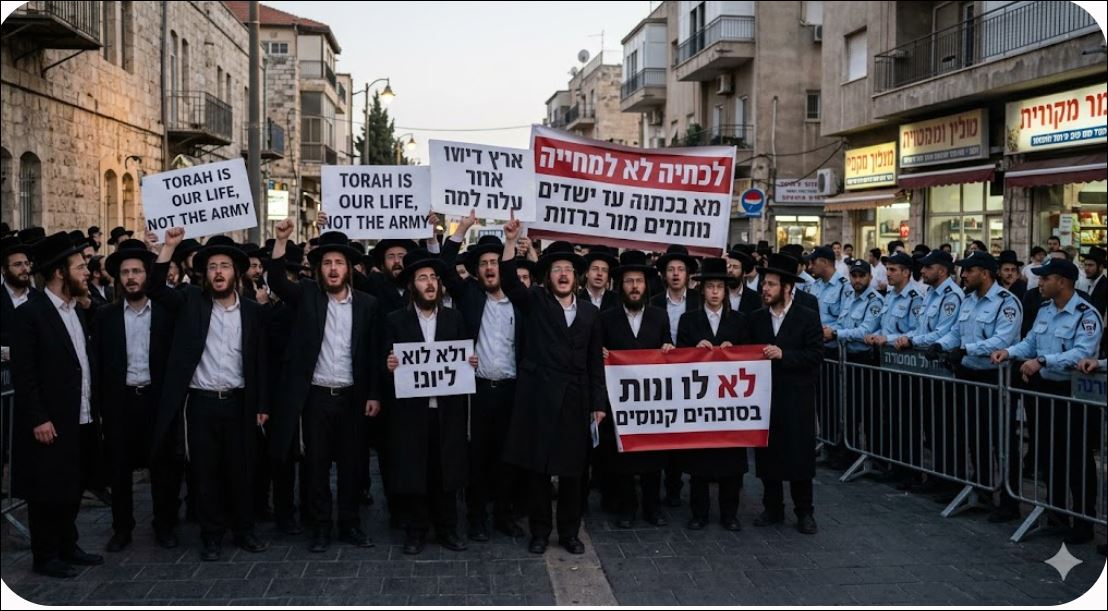 The incident you are referring to happened very recently, on the night of June 3, 2026, targeting the home of Supreme Court Justice Noam Sohlberg.
Here is exactly what transpired, followed by an analysis of the media dynamics and the reaction in right-wing talkbacks.
What Happened?
A group of dozens of extremist Haredi (ultra-Orthodox) protestors descended on the private residence of Justice Sohlberg in the West Bank settlement of Alon Shvut. Sohlberg and his wife were inside the home at the time.
-
The Vandalism: The demonstration quickly turned violent. Protestors shattered a bathroom window of the house with stones and smashed flower pots at the doorstep.
-
The Cause: The riot was staged to protest the ongoing legal enforcement and arrests of ultra-Orthodox draft evaders following the expiration of military draft exemptions.
-
The Police Response: Police dispatched to the scene blocked a bus that the suspects used in an attempt to flee, leading to the arrest of dozens of rioters.
While political leaders across the spectrum—including Prime Minister Benjamin Netanyahu, Justice Minister Yariv Levin, and National Security Minister Itamar Ben-Gvir—strictly condemned the violence, the reaction in the comment sections (“talkbacks”) of right-wing and religious news outlets told a different, more complex story.
Why Right-Wing Talkbacks Are Supportive or Ambivalent
The ambivalence or outright support seen in right-wing public forums doesn’t necessarily stem from a love for Haredi draft rioters (whom many national-religious right-wingers actually disagree with on the draft issue). Instead, it is driven by deeply entrenched political grievances against the judicial system.
The sentiment breaks down into three main arguments:
1. The “Selective Enforcement” Grievance
This is by far the most dominant theme. For years, right-wing commentators and citizens have argued that the justice system, police, and state attorney treat left-wing and right-wing protestors with double standards.
-
The Logic: Talkbacks frequently reference the massive anti-government/anti-judicial reform protests from 2023–2025. Commenters point out that those protestors blocked major highways (like the Ayalon), lit fires on roads, and demonstrated loudly outside ministers’ private homes for months with relatively few severe indictments.
-
The Sentiment: When right-wing media consumers see immediate, aggressive condemnations and mass arrests for a Haredi riot, their immediate reaction is: “Where was this outrage when left-wing protestors were blocking the country?” Even if they dislike the vandalism, they refuse to condemn it because they feel the system’s outrage is hypocritical.
2. The Supreme Court’s Unprecedented Crisis of Legitimacy
The Israeli right wing has spent years framing the Supreme Court not as a neutral arbiter of law, but as an activist, unelected political actor that consistently thwacks down right-wing policies. Just days prior to this incident, Supreme Court President Isaac Amit openly warned that public incitement and fake news targeting judges had reached an “unprecedented low.”
-
The Sentiment: Because the court is viewed by these factions as an adversarial political branch rather than a sacred democratic shield, a physical attack on a judge’s home is viewed by radical talkbackers less like “an attack on democracy” and more like “political blowback.”
3. The Irony of Justice Sohlberg Being the Target
There is a bitter irony that frames the ambivalence: Justice Noam Sohlberg is himself a conservative, religious, kippah-wearing judge who lives in a West Bank settlement. He was originally appointed to the bench as the conservative counter-weight to liberal judicial activism.
-
The Sentiment: Right-wing talkbacks exhibit a sort of grim amusement or detachment here. Some express a feeling of “even when a judge is one of ‘ours,’ the institution he serves is so broken that chaos finds him anyway,” while others mock the Haredi protestors for mistakenly targeting the most conservative judge on the bench.
Ultimately, the talkbacks reflect a tribalized political climate where the act of vandalism itself is secondary. For the commenters, the incident is simply a mirror used to validate their pre-existing anger over judicial power and perceived double standards in law enforcement.

Comment by the Editor: I think a good way to stop the chaos is to support Moshe Feiglin’s plan for direct election of Supreme Court Judges for a 7 year term. Feiglin claims that 22 states in the USA have direct elections for their state Supreme Courts.
I wish to clarify that Feiglin’s proposal is a step in the right direction but still is not sufficient to undo all the havoc caused by judicial activists.
I also wish to clarify that I do not share the hashkafa of the draft rioters and I have no influence over them.