
Shabbat Shalom. This Shabbat, we read a double portion: Tazria and Metzora. It is also the Shabbat of the New Month (Rosh Chodesh), so the Haftarah (prophetic reading) is not the usual one. However, I want to discuss the Haftarah typically read for Parashat Metzora.
These portions begin with the laws of childbirth but primarily focus on Tzara’at (often translated as leprosy). This is a very unique “illness”—the afflicted person does not go to a doctor; they go to the Kohen (Priest).
The Kohen is the one who diagnoses and purifies them. From this, we learn that we aren’t talking about a pathological disease treatable with antibiotics, Advil, or even chemotherapy. We are talking about a spiritual illness. The one capable of treating it is the Kohen—the bridge between the individual and G-d, and between the People of Israel and their Father in Heaven.
There are three types of afflictions: those affecting the person, their clothing, and their home. The Torah describes various symptoms—white patches, streaks, or swellings—and the Kohen must be an expert in identifying these specific appearances.
Social Isolation and the Root of the Affliction
One detail always strikes me: the Metzora (the afflicted person) must undergo a period of isolation. The Torah commands: “He shall dwell alone; his dwelling shall be outside the camp.” Our Sages teach us why these afflictions occur. In the Talmud (Tractate Arachin), Rabbi Yonatan states that they result from seven specific sins. This isn’t a random sickness; it doesn’t happen because someone went out in the cold without a coat. While the Sages say “all is in the hands of Heaven except for chills and fever” (meaning we are responsible for our physical health), Tzara’at is a divine response to social transgressions:
- Evil speech (Lashon Hara)
- Bloodshed
- False oaths
- Sexual immorality
- Arrogance
- Theft
- Stinginess
Most of these involve social relationships—how we treat one another. Specifically, they focus on what comes out of our mouths. The tongue is described as a “sharpened arrow”; we can use our speech to “kill.” When we slander someone, we destroy their reputation and their standing in society.
The message is clear: the social division you create with your tongue is reason enough for the Torah to tell you, “My friend, sit outside the camp. Do not sit among people until you reflect on your actions.” If you want to be part of a society, you must act like a human being. You must be responsible for your words because they have the power to destroy the fabric of a community.
Looking at our society today, it feels like the flames of mutual accusation have reached a peak that is difficult to extinguish. We are tearing ourselves apart from within. Every one of us must look inward and ask how we can lower these flames—how to offer criticism in a measured, constructive way that doesn’t lead to total social disintegration.
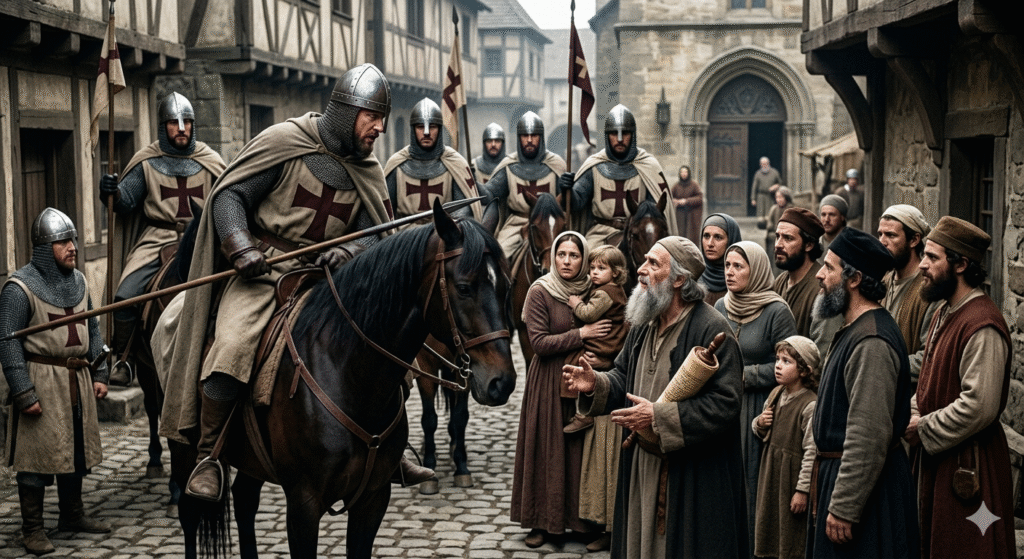
History and Heroism: The Crusades of 1096
This week, we also mark Israel’s Independence Day. The Exile (Galut) is a desecration of G-d’s Name, while our sovereignty is a sanctification of it. To appreciate the light, we must look at the darkness.
This week marks 930 years since the Crusades and the massacres of 1096 (known in Jewish history as Gzerot TaTNu). Three magnificent Jewish communities in Germany were destroyed: Speyer, Worms, and Mainz (collectively known by the Hebrew acronym SHUM). In the Ashkenazi tradition, we recite a special prayer (Av HaRachamim) on Shabbat for these holy communities who gave their lives in sanctification of G-d’s Name (Kiddush Hashem).
During the Crusades, mobs of “Crusaders”—often thugs and criminals led by religious figures—marched toward Jerusalem, massacring Jewish communities along the way. While their primary motive was often plunder, they did so in the name of the “Sword of Love,” attempting to force Jews to convert to Christianity.
Martyrdom and Devotion
The Jews of that era refused to abandon their faith. The contemporary chronicles describe it vividly:
“In that year, Passover fell on a Thursday… and on the eighth of Iyar, the Sabbath day, enemies rose against the community of Speyer… they did not wish to be defiled by their ‘foulness’ (baptism).”
The Sages used the term “foulness” to describe the waters of forced baptism. Scholars of that time, such as the Ba’alei HaTosafot, debated the harrowing halakhic question: Was it permissible for a person to take their own life, or even the lives of their children, to avoid being forcibly converted? They concluded that these were acts of supreme heroism intended to preserve their devotion to G-d.
In Worms, the community was split: some stayed in their homes while others fled to the local ruler, hoping for protection. It didn’t help. The descriptions are gut-wrenching: homes were destroyed, Torah scrolls were trampled in the mud and burned, and on the first day of Sivan—the day the Israelites originally reached Sinai—those hiding with the Minister were also slaughtered. They accepted the “Divine Decree” with a whole heart, crying out Shema Yisrael.
Out of 800 people in one community, only a handful survived. There is a story of a young man named Simcha HaKohen who, when taken to a church to be forcibly baptized, drew a knife from his sleeve, killed the Minister’s relative, and was immediately killed himself.
From Darkness to Light: Rashi to the Present Day
The great commentator Rashi lived during this time. Born in 1040 and passing in 1105, he lived through the horrors of 1096. He and the subsequent Sages discussed the prohibition against suicide (“But for your own life-blood I will require a reckoning”), explaining that in extreme cases of forced idolatry or unbearable torture, giving one’s life was a holy act, much like King Saul on Mt. Gilboa.
Rabbi Meir of Rothenburg (13th century), who died in a German prison because he refused to let the Jewish community ransom him (so as not to encourage the kidnapping of more rabbis), wrote: “May the Rock of Israel avenge our blood… may our eyes see it and our hearts rejoice.” In those days, justice was a distant dream.
The Miracle of Our Generation
By the grace of G-d, after nearly a thousand years, we are back in the Land of Israel. Today, when we have proper leadership, we have the ability to pursue and overtake our enemies. May we continue to fulfill the verse: “I pursued my enemies and overtook them, and did not turn back until they were consumed.”
I want to conclude with the words of Rabbi Samson Raphael Hirsch. Living in mid-19th century Germany, a time of secularization and reform, he said something piercing:
“If the martyrs of the Crusades were to rise from their graves and meet their descendants who have abandoned the Torah, they wouldn’t recognize them. They would ask: ‘We slaughtered our own infants and gave our lives to preserve the holiness of Israel—and you throw it all away by choice?'”
The lesson for us is to realize that G-d has remembered His people. We live in a time of great merit—the “advantage of light over darkness.” If Rashi or the Maharam of Rothenburg were alive today, they would be composing songs of joy that the People of Israel have returned to their land, their language, and their names. The words of the Prophets are being realized through us.
We must remember: The Eternity of Israel does not lie. We are a nation only by virtue of our Torah. This is what makes us unique and holy. May we never abandon it by choice.
Shabbat Shalom! Please feel free to share.
Editor’s comment: We see in the Beit Yosef’s commentary that it was a dispute among the rabbis regarding which measures could be used to prevent forced baptism.

Beit Yosef on Tur, Yoreh De’ah, Siman 157.
This passage from the Beit Yosef (specifically the Bedek ha-Bayit additions) in Yoreh De’ah 157 discusses one of the most agonizing dilemmas in Jewish law: whether a person is permitted to take their own life—or the lives of others—to avoid forced conversion or extreme torture during a period of religious persecution (Sha’at ha-Shmad).
Here is the translation and a breakdown of the arguments presented.
Translation: Beit Yosef, Yoreh De’ah 157
The Scriptural Source It is written in the Orchot Chaim (Laws of Loving God, Ch. 4), citing Bereishit Rabbah (34:13), which expounds on the verse: “But (Ach) for your own lifeblood I will require a reckoning” (Genesis 9:5). This verse serves as a warning against one who “strangles his own soul” (commits suicide).
The Exception for Martyrdom One might think this prohibition applies even to cases like Hananiah, Mishael, and Azariah (who gave their lives rather than worship an idol). Therefore, the Torah says “Ach” (But/However). This implies that during a time of forced apostasy, a person may hand himself over to death or even kill himself if he fears he will be unable to withstand the trial (and would otherwise sin).
The Case of King Saul Similarly, it applies to cases like Saul son of Kish, who feared he would be subjected to cruel tortures [by the Philistines]; he may hand himself over to death, as the verse says “Ach.”
The Debate Over Killing Children
From this, some bring proof for those who slaughtered children during times of persecution [to prevent them from being raised as idolaters].
However, others forbid it. They interpret the word “Ach” differently:
-
Suicide is forbidden: A person may not kill himself.
-
Passive vs. Active: Hananiah, Mishael, and Azariah merely handed themselves over to the hands of others to be killed; they did not strike themselves.
-
King Saul: He acted against the will of the Sages.
The Tale of the Two Rabbis
There is a story of a certain Rabbi who slaughtered many children during a time of persecution because he feared they would be forced to abandon their religion. Another Rabbi was with him, became angry, and called him a “murderer.” The first Rabbi did not heed his words.
The opposing Rabbi said: “If I am right, let that [first] Rabbi be killed by an unusual death.” And so it was: the gentiles captured him, flayed his skin, and placed sand between the skin and the flesh. Afterward, the decree of persecution was nullified. Had he not slaughtered the children, it is possible they would have been saved and not killed at all.
Key Halakhic Concepts
-
The Power of “Ach” (אך): In Midrashic hermeneutics, the word Ach is a “limitation” (Mi’ut). It suggests that while suicide is generally a capital crime in the eyes of Heaven, there are specific, extreme circumstances where the rule is set aside.
-
Fear of Failure: The text highlights a psychological component. The permission (according to the first view) isn’t just about dying for G-d; it’s about the fear that torture will break the person’s will, causing them to betray their faith.
-
The Moral Warning: The concluding story serves as a chilling “cautionary tale.” Even when acting out of religious zeal, the shedding of innocent blood is viewed with extreme gravity. The fact that the decree was nullified shortly after the children were killed suggests that the Rabbi acted with “unholy haste,” failing to trust in divine salvation.
In modern times there is a case that became headlines in the media of a father who acted based on the extreme position during a divorce dispute. I strongly recommend that a person faced with that situation get a halachic ruling from a great Posek. It appears to me that the Beit Yosef leans in the direction that one should not slaughter the children. But I wish to make it clear, I do not have the authority nor do I have the knowledge necessary to give clear halachic instruction on this heavy issue.
Comment #2: It is not so clear what was the historical reality regarding the events surrounding the jailing of Rabbi Meir of Rothenburg
For those that read Hebrew, see: https://tora-forum.co.il/attachments/%D7%94%D7%90%D7%9D-%D7%A1%D7%99%D7%A8%D7%91-%D7%9E%D7%94%D7%A8%D7%9D-%D7%9E%D7%A8%D7%95%D7%98%D7%A0%D7%91%D7%95%D7%A8%D7%92-%D7%9C%D7%94%D7%A9%D7%AA%D7%97%D7%A8%D7%A8-%D7%9E%D7%91%D7%99%D7%AA-%D7%94%D7%9B%D7%9C%D7%90-pdf.48511/